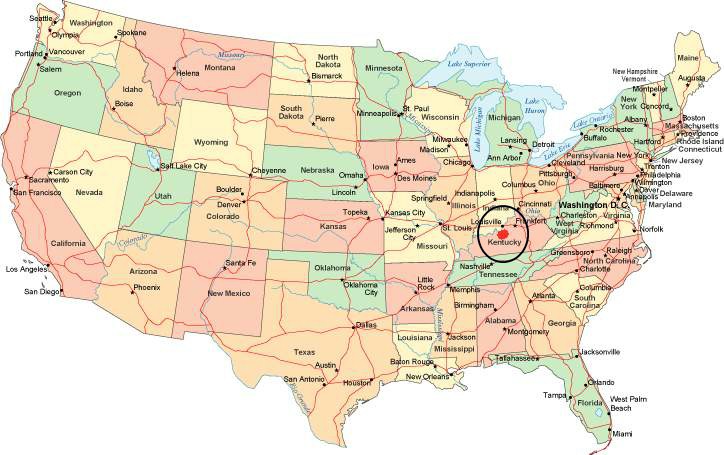
The United States Bullion Depository is a fortified vault
building located near Fort Knox, Kentucky which is used to
store a large portion of United States gold metal holdings,
as well as from time to time, other precious items belonging
to, or entrusted to, the United States of America.
The United States Bullion Depository holds approximately
4,570 tons of gold bullion. This is exceeded in the United
States only by the Federal
Reserve Bank of New York's underground vault in Manhattan,
which holds approximately 5,000 tons of gold in trust for
many foreign nations, central banks and official international
organizations.
Prior to the election of Franklin D. Roosevelt in 1932,
gold coins had circulated freely in the United States as
legal money, and gold bullion was owned by banks and other
private entities. In early 1933, as part of the New Deal,
the U.S. Congress enacted a package of laws which removed
gold from circulation as money, and which made private
ownership of gold in the U.S. (except for coins in collections)
illegal. All gold coin in circulation was collected by the
government and traded for other forms of money. Owners of
gold bullion in the U.S. were also required to trade it for
other forms of money. All of this left the government of the
United States with a lot of gold metal, and no place to store it.
In 1936 the U.S. Treasury Department began construction of
the United States Bullion Depository at Fort Knox, Kentucky
on land deeded from the military. The site is located on what
is now Bullion Blvd. at the intersection of Gold Vault Rd.
The 'Gold Vault' was completed in December 1936 at a
cost of $560,000.
The first gold shipments were made from January to July
1937. The majority of the United States' gold reserves
were gradually shipped to the site, including old bullion
and more newly made bars made from melted gold coins. Some
intact coins were stored, as well. The transfer needed 500
rail cars and was sent by registered mail, protected by the
Postal Inspection Service.
During World War II the depository also held the reserves
of a number of European countries as well as one of four
known copies (exemplifications) of Magna Carta (this one
had been sent for display at the 1939 New York World Fair
and when war broke out, was caught in America for the
duration), and other key documents from Western history.
It also held the official copy of the U.S. Constitution
for the duration of the war.
|
The above information was obtained at:
Wikipedia
And
Wikipedia
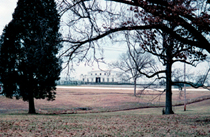
Fort Knox Bullion Depository
A large amount of the United States' gold reserves is stored
in the vault of the Fort Knox Bullion Depository, one of the
institutions under the supervision of the Director of the
United States Mint. The remaining gold reserves are held in
the Philadelphia Mint, the Denver Mint, the West Point
Bullion Depository and the San Francisco Assay Office, also
facilities of the United States Mint.
Amount of present gold holdings is 147.3 million ounces
(1 troy ounce equals about 1.1 avoirdupois ounces). The
only gold removed has been very small quantities used to
test the purity of gold during regularly scheduled audits.
Except for these samples, no gold has been transferred to
or from the Depository for many years. The highest gold
holdings was 649.6 million ounces, on December 31, 1941.
From the end of World War II through 1983, domestic mine
production of gold did not exceed 2 million ounces annually.
Since 1985, annual production has risen by 1 million to 1.5
million ounces every year. By the end of 1989, the
cumulative output from deposits in the United States
since 1792 reached 363 million ounces. Consumption of gold
in the United States ranged from about 6 million to more
than 7 million troy ounces per year from 1969 to 1973,
and from about 4 million to 5 million troy ounces per year
from 1974 to 1979, whereas during the 1970's annual gold
production from domestic mines ranged from about 1 million
to 1.75 million troy ounces. Since 1980 consumption of gold
has been nearly constant at between 3 and 3.5 million troy
ounces per year.
The price of gold was raised from $20.67 to $35 an ounce
in 1934. After the United States deregulated gold in 1971,
the price increased markedly, briefly reaching more than
$800 per troy ounce in 1980. Since 1980, the price has
remained in the range of $320 to $460 per troy ounce.
The Depository was completed in December 1936 at a cost of
$560,000. Building materials used included 16,000 cubic feet
of granite, 4,200 cubic yards of concrete, 750 tons of
reinforcing steel, and 670 tons of structural steel. It
is located approximately 30 miles southwest of Louisville,
Kentucky, on a site which was formerly a part of the Fort
Knox military reservation. The first gold was moved to the
Depository by railroad in January 1937. That series of
shipments was completed in June 1937.
During World War II, the U.S. Bullion Depository continued
to operate at Fort Knox, receiving more and more shipments
of the country’s gold reserves. The Gold Vault was also
used to store and to safeguard the English crown jewels
and the Magna Carta, along with the gold reserves of
several of the
countries of occupied Europe.
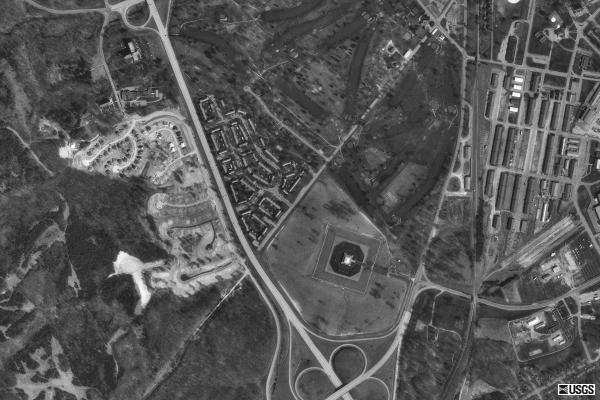
Satellite Photo of Fort Knox Bullion Depository
Over the marble entrance at the front of the building is the
inscription "United States Depository" with the seal of the
Department of the Treasury in gold. Offices of the Officer
in Charge and the Captain of the Guard open upon the
entrance lobby. At the rear of the building is another entrance
used for receiving bullion and supplies.
At each corner of the structure on the outside, but connected
with it, are four guard boxes. Sentry boxes, similar to the
guard boxes at the corners of the Depository, are located at
the entrance gate. A driveway encircles the building and a
steel fence marks the boundaries of the site. The building
is equipped with the latest and most modern protective
devices. The nearby Army Post provides additional protection.
The Depository is equipped with its own emergency power plant,
water system and other facilities. In the basement is a
pistol range for use by the guards.
The gold stored in the Depository is in the form of standard
mint bars of almost pure gold or coin gold bars resulting
from the melting of gold coins. These bars are about the
size of an ordinary building brick, but are somewhat smaller.
The approximate dimensions are 7 x 3-5/8 x 1-3/4 inches.
The fine gold bars contain approximately 400 troy ounces of
gold, worth $16,888.00 (based on the statutory price of
$42.22 per ounce). The avoirdupois weight of the bars is
about 27-1/2 pounds. They are stored in the vault compartments
without wrappings. When the bars are handled, great care is
exercised to avoid abrasion of the soft metal.
The Depository is headed by an Officer in Charge, who is
responsible for ensuring the security of the gold. The
guard force is composed of men selected from various
Government agencies, or recruited from Civil Service
registers. No visitors are permitted at the Depository.
This policy was adopted when the Depository was established,
and is strictly enforced.
The above information was obtained at:
Global Security
|