Before industry and technology gave
us sawmills and frame houses, this is how the average
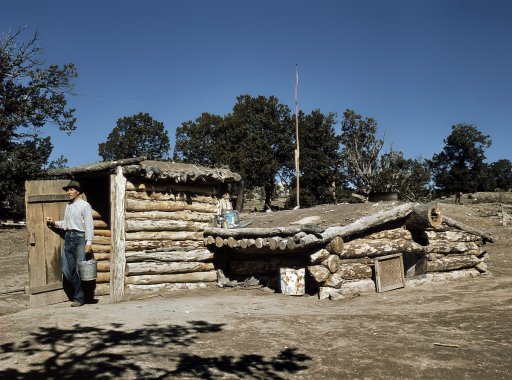
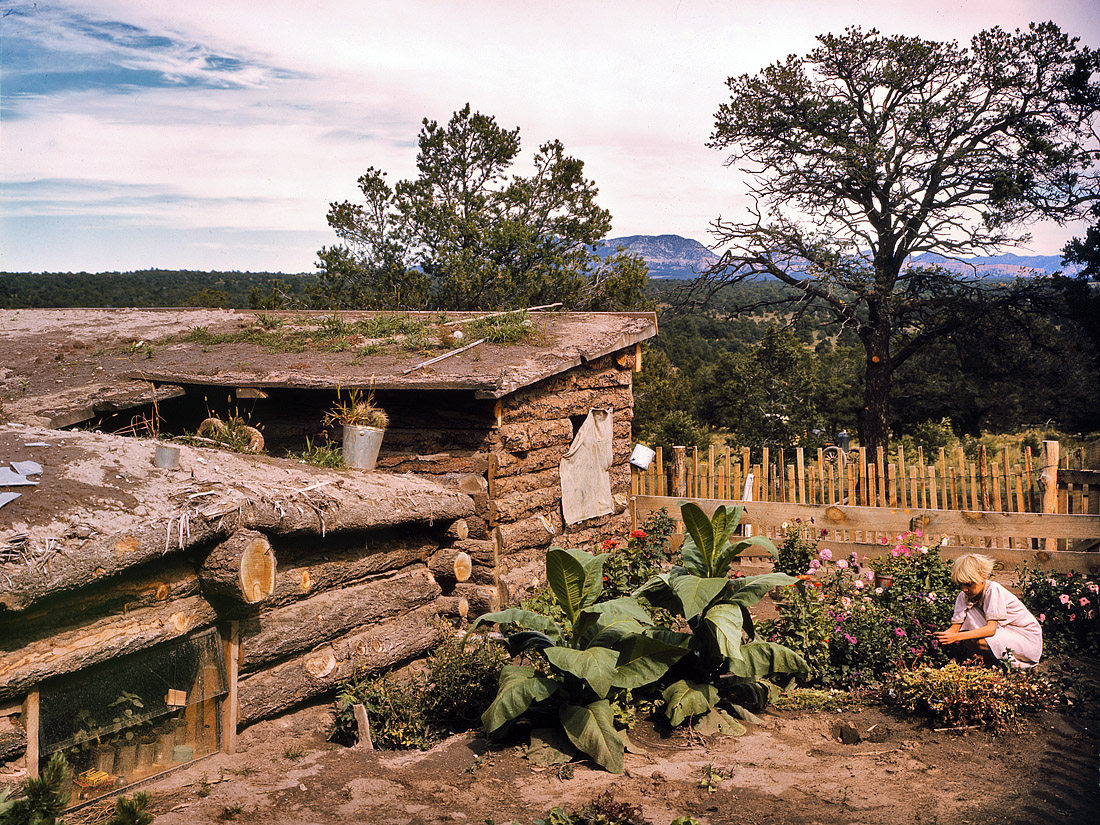
person lived in much of the world. The dugout or pit house,
with sod roof, log walls and earthen floor, is among
the most ancient of human dwellings -- at some point
in history your ancestors lived in one. Especially
popular among 19th-century settlers in the Great Plains
and deserts of the West and Southwest, where trees and
other building materials were scarce, dugouts were
warmer in winter and cooler in summer than above-ground
structures; just about anywhere in North America the
ground temperature three feet down is 55 degrees
regardless of the season.
Shelter was the first essential and homesteaders who
pioneered were resourceful men. They had brought a few
farming tools along and first in importance was the
heavy iron breaking plow. Drawn by a team of horses
or oxen, this instrument could turn up an eighteen
inch ribbon of the thick virgin prairie sod. The strip
could then be cut into two foot sections, four to six
inches deep, to make an almost perfect building block.
The first – and most desirable – homes were simply small
rooms dug into the lee side of a low rolling hill. The
walls were built up with sod blocks to a height of seven
or eight feet. Holes were left for doors and windows
which were usually store-bought and hauled from the
nearest town or railroad point. Cottonwood poles laid
side by side, then spread with a thick layer of coarse
prairie grass to provide insulation and prevent dirt
from sifting through, formed the roof. Over this was
carefully fitted a double layer of the sod building
blocks. The first good rain started this sod to growing
and soon the dugout roof was covered with waving grass.
The grass almost concealed the roof but did not affect
its insulating or protective properties.
The floor of the dugout home was of rough wooden planks
if the family could afford to buy them. Otherwise, it
was treated as the neighboring Indian squaws treated
their tipi floors: Sprinkled with water daily and swept
with crude grass brooms until the surface was a hard and
smooth as finished concrete.
Walls of the sod houses were lined with newspapers
pasted or pinned up with small, sharpened sticks to keep
the, dirt from brushing off. Some of the more ambitious
families located outcroppings of limestone rock which
they burned and mixed with screened sand to make a
plaster coating for the walls.
The dugouts were amazingly comfortable homes; cool in
summer, snug and easily heated in winter. The thick sod
walls and roof made excellent insulation in a day when
few knew or appreciated the value of insulation. When
properly located on the south side of a low hill, with
adequate drainage to provide run-off for rain and melting
snow, the dugout was probably as comfortable a home as
any our pioneering forefathers ever knew.
Unfortunately, the pioneer dugout had a very short life.
It couldn't stand prosperity. With money
in the bank, the status symbol was a clap board house and
grandma couldn't be satisfied until she had gotten her
family out of "that hole in the ground" and into her
uninsulated clapboard structure: A house that was stifling
hot in the summer and poorly heated in the winter by buffalo
chips in the kitchen range or costly storebought coal that
had to be hauled from town, carefully hoarded and
sparingly doled out.
Prosperity put an end to the dugout in little more than a
decade of pioneering, but a few pictures still exist to
show how these homes looked and memories and journals of
the oldtimers record the dugout's comforts and advantages
. . . advantages that are still available to today's
pioneers, homesteaders and freedom folk who want to get
away from big city congestion and find a quiet, simple
life close to the land.
|