TARGET 070509
Funambulism
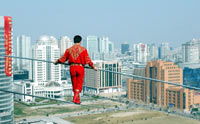
Ahdili, known as China's Prince of Tightrope Walking, completed
a 480-meter tightwire walk between two high-rise buildings in
Shantou in Guangdong Province, China.
(Note: The tasking for this target session was to describe the
activity of tightrope walking, not the incident of Ahdili's walk
between the high-rises. If you described the event, it probably
also described the activity. If you only described the activity,
you do not need to feel that you missed anything because you
didn't describe the specific event pictured above.)
|
While it may sound like the latin name for tightrope walking sounds
like having fun, the derivation of the word is actually:
funambulism: v. Tightrope walking. From the Latin funis
(rope) and ambulare (walk).
Imagine yourself 20 meters (66 feet) above the ground on a platform,
as thousands of faces watch and wait for you to style.
(to style: v. Circus term for a performer's particular way
of bowing and posing to acknowledge the audience.)
Now imagine taking a step, with only a 1/2-inch metal wire between
you and the ground. Welcome to the world of high wire.
High wire's roots are as old as ancient Egypt and first century
China, where the art of "rope dancing" was performed over knives.
In the 1850s, Jean Francois Gravelet received world acclaim for
cooking and eating an omelette (complete with stove and neatly
set table) on a high wire stretched over Niagara Falls.
Three different types of funambulism have evolved:
Slack wire, where the rope or wire hangs a bit loose, is
popular for juggling, clowning, and sword fights.
Sloped wires, where the rope is attached to the ground at
one end and to a pole at the other, creating an angle of about
40 degrees.
The most popular of all is the high-wire act, where a taut,
springy wire is used to launch dizzying acrobatic tricks and
phenomenal feats of balancing.
One way to view the high-wire act is to see the wire as an axis
and the center of mass of the performer as having the potential
to rotate about the axis. If the center of mass is not directly
above the wire, gravity will cause the performer to begin to
rotate to one side. If this is not corrected, the performer
will fall.
The artist often carries a balancing pole that may be as long as
12 meters (39 feet) and weighs up to 14 kilograms (31 pounds).
This pole increases the rotational inertia of the artist, which
allows more time to move his or her center of mass back to the
desired position directly over the wire. This effect can be
magnified by making the pole as long as possible and by weighting
its ends. The pole also helps balance the funambulist by lowering
the center of gravity. High-wire artists use drooping, rather
than rigid, balance poles. It's possible, in fact, to have
such heavy weights attached to the ends of a long, drooping
pole that the center of gravity of the performer/pole system
is below the wire. In this case, the performer would require
no more sense of balance than a person hanging from the wire.
Acrobats train for years and use mechanics to safely develop
routines. Although a high-wire performance may seem like a
combination of courage and magic, remember that there's a
lot of work and good, old-fashioned physics thrown into the
balance as well!
|
