
TARGET 061213
Nasa's Reduced Gravity Research Program
|

|
|
Watch NASA Movie
(Requires Quick Time) |
|
"Vomit Comet" is a nickname for any NASA airplane that briefly
provides a nearly weightless environment in which to train
astronauts, conduct research, and film motion pictures.
Versions of this airplane have been operated by NASA's Reduced
Gravity Research Program since 1973. NASA prefers the nickname
"Weightless Wonder" for public relations reasons.
|
Ups and Downs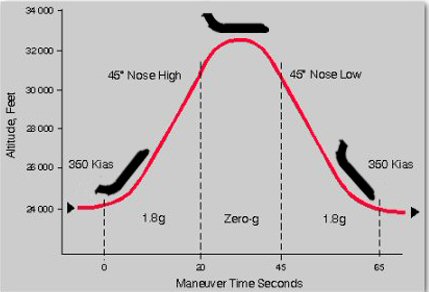
|
|
The above diagram shows a typical zero-g maneuver. However, the
maneuver can be modified to provide any level of g-force less
than one g. Some typical g-levels used on different tests and the
corresponding time for each maneuver are as follows:
* Negative-g: (-0.1 g): Approximately 15 seconds * Zero-g: Approximately 25 seconds * Lunar-g: (one-sixth g): Approximately 40 seconds * Martian-g: (one-third g): Approximately 30 seconds The NASA Reduced Gravity Program operated by NASA Lyndon B. Johnson Space Center (JSC) in Houston, Texas, provides the unique "weightless" or "zero-g" environment of space flight for test and training purposes on a cost-reimbursable funding basis. With the coming of age of the Space Transportation System and the current plans for the Space Station, this capability is ideal for the development and verification of space hardware, experiments, crew training and it is also ideal for doing basic research. |
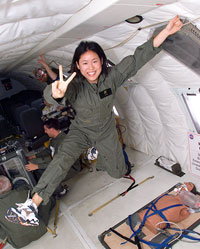
A student experiences a moment of weightlessness aboard the KC-135A. |
|
Other maneuvers offer gravity equal to that on the surface of the
moon, 17 percent that of Earth, or of Mars, 38 percent that of
Earth. The Reduced Gravity Program was begun by the Air Force in
1957 to train people, develop procedures and test hardware in
weightlessness. It has been operated by NASA since 1973. More than
140,000 parabolas have been flown in a series of eight planes
since the program began.
|

|
|
The KC-135A is part of a family of military planes descended from
the Boeing 707 four-engine jet aircraft. The KC-135A began life as
a tanker. This will be the last of the KC-135As to be used in the
Reduced Gravity Program. It is to be replaced by a Navy C-9, a twin-jet
variant of the McDonnell Douglas DC-9.
|

|
|
This airplane, NASA 931, came to the space agency in late 1994. It
succeeded NASA 930, which NASA acquired in 1973 and flew more than
58,000 parabolas before being retired in 1995. It is displayed at
Ellington Field near Houston.
Astronaut candidates are required to fly in the microgravity program as part of their training. Engineers test equipment and procedures designed for spaceflight. Scientists do basic research on board. Some scenes from the movie "Apollo 13" were filmed on a NASA KC-135A. The plane typically flies four days a week. Since 1995, college students have been able to participate in the NASA Reduced Gravity Student Flight Opportunities Program. They design experiments for microgravity and apply to take part in the program. The experiment of each student team selected is subjected to a rigorous safety inspection before it is flown. Student experiments are flown twice, each time with two members of the four-member student teams. Journalists sometimes fly with the student teams to cover their activities. More than 2,000 students have flown on the KC-135A. Their experiments have included physical and biological investigations as well as engineering experiments. Yaniec, who himself has flown almost 31,000 parabolas without a hint of airsickness, said he has enjoyed seeing the excitement on the students' faces while they conduct their experiments. |

|
|
He said the program "helps pave the way for students to conduct cutting-edge
research experiments" that may help lead some of them toward making major
contributions to human knowledge and capabilities. The program is important
in NASA's efforts to inspire the next generation of explorers.
Would you like to ride the "Vomit Comet"? A company called "XperienceDays" provides this service. Their website can be found at http://www.xperiencedays.com/Xperience/View.aspx?ProductId=33 offers this ride for a mere $3910. See their web site for details. Information about the Vomit Comet was obtained from these sites: Nasa/JSC Aricraft Operationsall of which contain a wealth of further information for feedback to your session. Our grateful thanks fo Ray McClure for doing the research and development of this target. |